

- This event has passed.
Correspondences
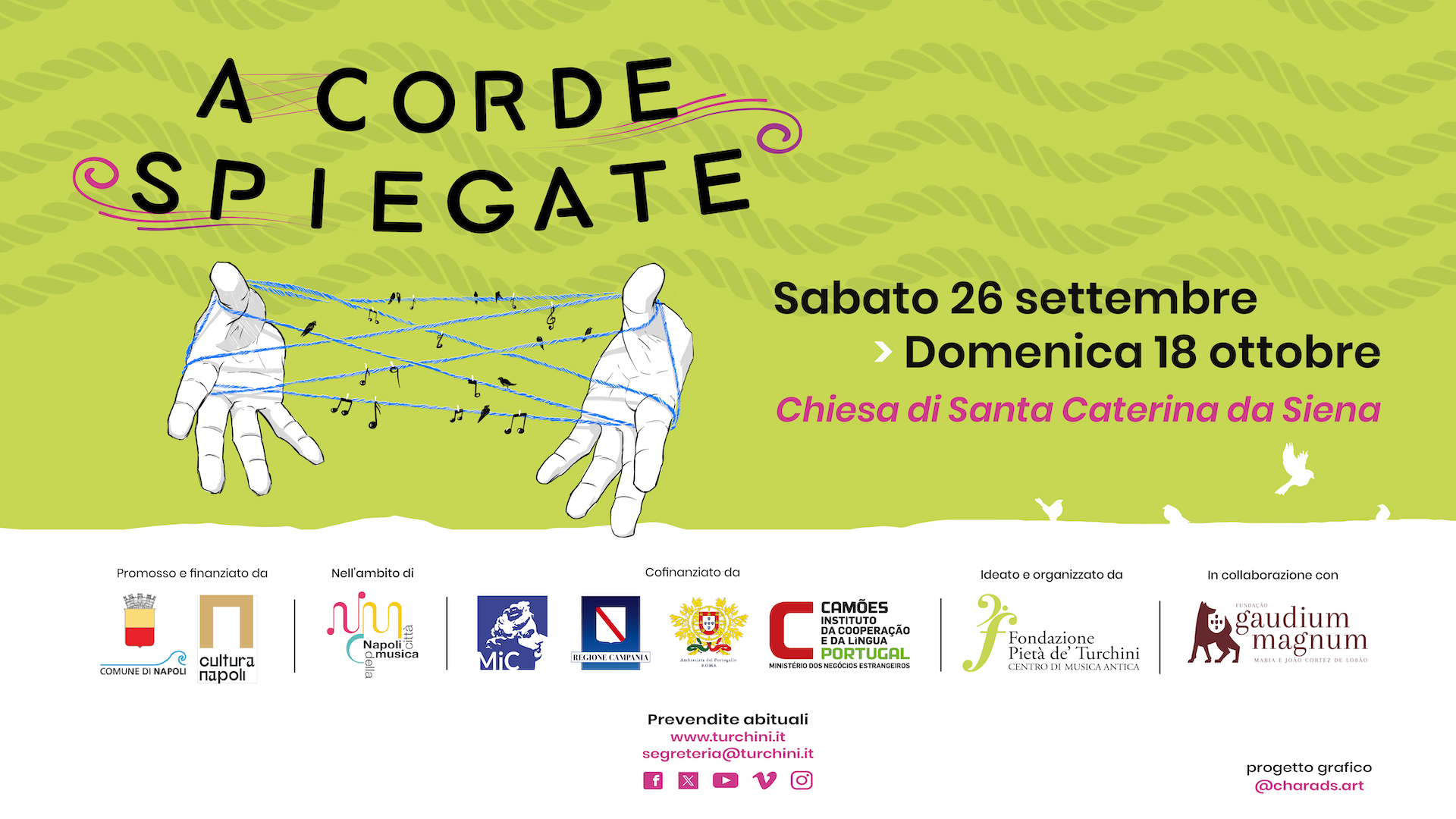
Festival "A Corde Spiegate"
- Ticket: € 5,00 €
for the series
A Corde Spiegate
Performers
Paolo Rigano, archlute and Baroque guitar
Cinzia Guarino, harpsichord
The initiative is promoted and co-financed by the City of Naples as part of its 2026/2027 cultural programme.
TICKETS AVAILABLE ON SITE AND IN ADVANCE
Advance tickets can be purchased:
– online on the TicketOnLine – Azzurro Service website, no later than 12:00 noon on the day of the concert;
– at the designated Azzurro Service sales points;
– at the Concerteria sales point (via Michelangelo Schipa 15) or by phone at +39 0817611221.
RECOMMENDED PARKING
GARAGE GREEN PARKING NAPOLI
Via S. Carlo Alle Mortelle, 80132 – Naples
tel: 081 418515
directions
Further information
segreteria@turchini.it
Programme
Tiziano Bagnati (1960)
Preludio e passacaglia
Andrea Falconieri (1585-1656)
Il Spiritillo Brando
Santiago de Murcia (1673-1739)
Fandango
Arcangelo Lori (17th century)
Toccata dell’Arcangelo
Alessandro Scarlatti (1649-1725)
Toccata Nona
Anonymous (17th century)
Bertoncina
Gaspar Sanz (1640-1710)
Domenico Pellegrini (17th century)
Chiaccona in Parte variate alla vera Spagnuola
Luigi Boccherini (1743-1805)
Fandango (arrangement for duo by Cinzia Guarino)
Domenico Scarlatti (1685-1757)
Sonata K. 32, Aria
Domenico Scarlatti (1685-1757)
Sonata K. 517
Paolo Rigano (1957)
Corrispondenze
Wayward Thoughts (on the occasion of the 400th anniversary of the death of John Dowland)
Correspondences
Programme Notes
Correspondences – like the interweaving of the sounds of the archlute and the harpsichord, but also like the interweaving of cultures, the Sicilian and the Spanish.
This is the starting point from which the project by Paolo Rigano (archlute and guitar) and Cinzia Guarino (harpsichord and organ) was born. This artistic duo, founders of the Arianna Art Ensemble and of the MusicaMente Association in Palermo, present a programme featuring a selection of works from the Italian and Spanish repertoire of the period between the seventeenth and eighteenth centuries.
An album that brings together works composed for lute, guitar, harpsichord, or chamber ensemble, to which is added a further piece, composed in a contemporary idiom by Paolo Rigano himself for archlute and harpsichord. It is precisely from this last piece that the album takes its title, Corrispondenze (“Correspondences”).
The originality of the project lies in the fact that works originally written for guitar, archlute, or harpsichord are performed as duos, with the guitar or archlute in dialogue with the harpsichord. Specifically, in the chosen repertoire, the harpsichord interacts with the archlute and the Baroque guitar, at times taking on the role of basso continuo, at times that of interweaving, moving between exchanges of parts and moments of improvisation.
Boccherini’s Fandango, drawn from the Quintet in D minor for guitar and strings G. 448, was transcribed for harpsichord by Cinzia Guarino, while the Baroque guitar performs the part written by the composer. In two pieces — Zamboni’s sarabande and Lori’s toccata — the organ is used, taking on a role of harmonic support for the archlute. Improvisation is part of the interweaving of the parts between the two musicians, with an inventiveness that stems from the way they share the melodic and accompanying roles between them — sometimes exchanging the role of lead instrument, sometimes trading phrases, sometimes joining together in unison.
The album’s title, Corrispondenze, underlines the mutual relationship, the reciprocity between the two instruments and between the musicians, but also the correspondences and affinities between the chosen pieces. These correspondences are evident between Boccherini’s Fandango and that of De Murcia, but also among the other works by Italian and Spanish composers — all as if to underline the artistic and cultural affinities between the two peoples. Further confirmation of these cultural affinities is offered by Corelli’s Giga, probably written by De Murcia after hearing a concert by Corelli during a journey to Italy; or again the Canario, a Spanish folk dance yet often used by Italian composers of the period; and the compositions of Domenico Scarlatti, born in Italy but greatly admired in Spain.
Cinzia Guarino and Paolo Rigano, founders of the Arianna Art Ensemble and of the MusicaMente Association in Palermo, have been engaged for fifteen years in the promotion and dissemination of historically informed music, with particular attention to the rediscovery of unpublished musical heritage. They do not, however, neglect experimentation and the performance of contemporary works, remaining faithful to their commitment to promoting young talents and giving them the opportunity to perform side by side with the leading figures of the international music scene. Among their many collaborations with great internationally renowned soloists are those with Giovanni Sollima, Dmitry Sinkovsky, Enrico Onofri, Gemma Bertagnolli, Eugenio Bennato, Tiziano Bagnati, Giovanni Antonini, Chiara Zanisi, and many others.
The MusicaMente Association – a member of AIAM, and a beneficiary of funding from the FUS (MiBACT) and the FURS of the Sicily Region – also organises tours in Italy and abroad to promote the recording projects of the Arianna Art Ensemble, as well as two festivals, one in summer and one in winter, held in various provinces of Sicily and featuring exceptional guests, for the dissemination of early music.