

- This event has passed.
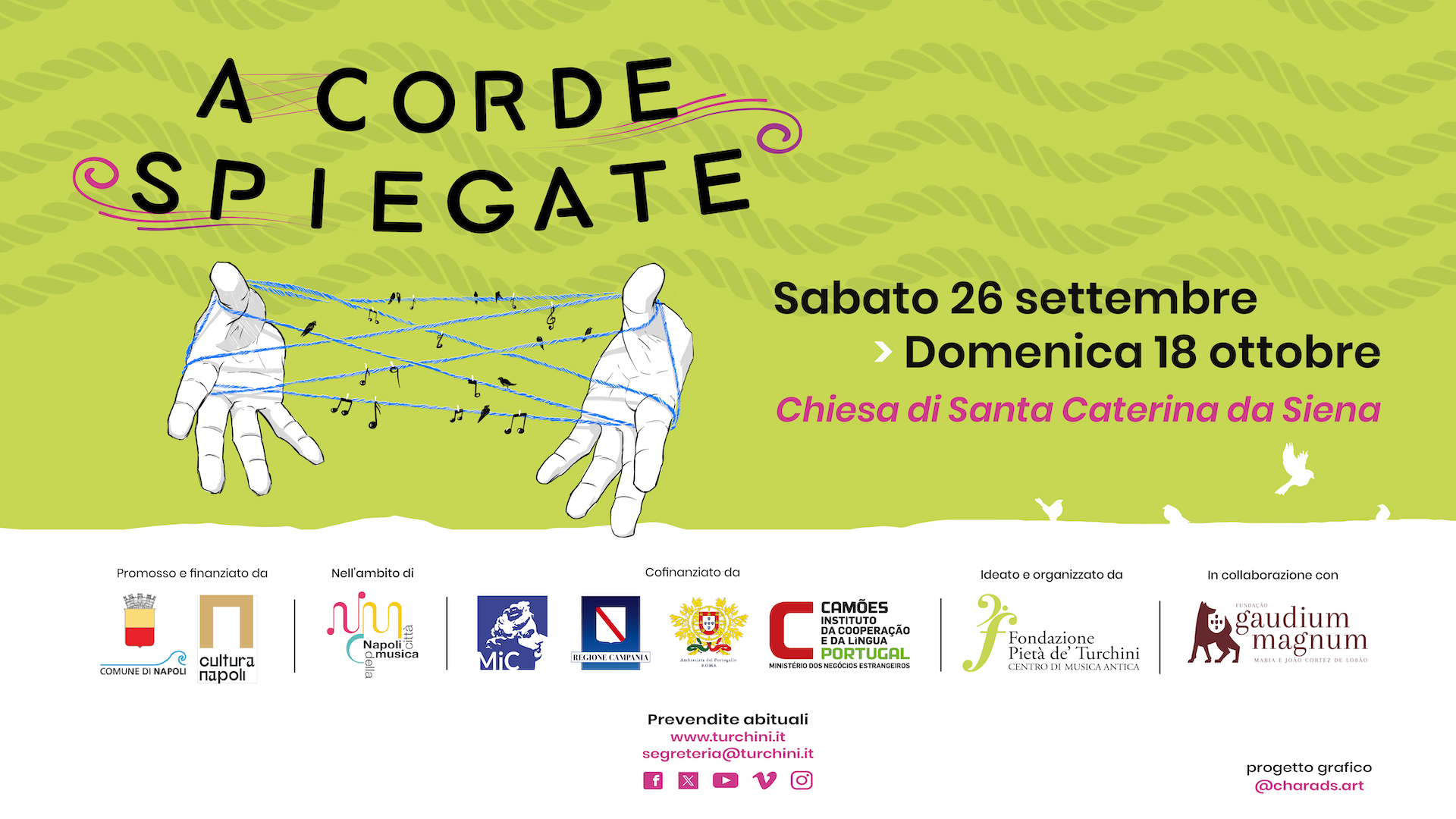
Dowland meets Marenzio
Festival "A Corde Spiegate"
- Ticket: € 5,00 €
for the series
A Corde Spiegate
Performers
Ring Around Quartet
Vera Marenco, soprano
Manuela Litro, alto
Umberto Bartolini, tenor
Alberto Longhi, baritone
Massimo Lonardi, lute
Giuliano Lucini, lute
Federico Bagnasco, viola da gamba
The initiative is promoted and co-financed by the City of Naples as part of its 2026/2027 cultural programme.
TICKETS AVAILABLE ON SITE AND IN ADVANCE
Advance tickets can be purchased:
– online on the TicketOnLine – Azzurro Service website, no later than 12:00 noon on the day of the concert;
– at the designated Azzurro Service sales points;
– at the Concerteria sales point (via Michelangelo Schipa 15) or by phone at +39 0817611221.
RECOMMENDED PARKING
GARAGE GREEN PARKING NAPOLI
Via S. Carlo Alle Mortelle, 80132 – Naples
tel: 081 418515
directions
Further information
segreteria@turchini.it
Programme
John Dowland (1563-1626)
Now, o Now
(The First Booke of Songes, 1597)
Anonimo inglese
La Rossignol
John Dowland
Can she excuse me
(The First Booke of Songes, 1597)
Anonimo inglese
Cupararee
John Dowland
If my complaints
(The First Booke of Songes, 1597)
John Dowland
My Lord Willoughby’s Welcome Home
Flow my tears
(The Second Booke of Songes, 1600)
John Dowland
Come again
(The First Booke of Songes, 1597)
***
Anonimo italiano
La Paduana del Re
Luca Marenzio (1553-1599)
Tutto il dì piango
(Il Primo libro de’ Madrigali a quattro voci, 1585)
Cesare Negri (1535-1605)
Bianco Fiore
Luca Marenzio
Occhi dolci e soavi
(Il Quarto libro delle Villanelle a 3 voci, 1587)
Anonimo italiano
La Rocca e il Fuso
Luca Marenzio
Lasso non è cor mio
(Il Primo libro delle Villanelle a 3 voci, 1584)
Zefiro torna e’l bel tempo rimena
(Il Primo libro de’ Madrigali a quattro voci, 1585)
Dowland meets Marenzio
Programme Notes
In 1594 the great English lutenist and composer John Dowland came to Italy. These were times when many musicians and painters from northern Europe undertook long and perilous journeys in order to make direct contact with the many artists thanks to whom our country enjoyed international prestige. Dowland’s principal aim was to meet the supreme composer Luca Marenzio in Rome, but the meeting never took place. The English lutenist nonetheless developed a fruitful relationship with Italian music, traces of which can be found in various aspects of his vocal and instrumental compositions.
Among all the great composer-lutenists active at the turn of the sixteenth and seventeenth centuries, Dowland stands out for his instrumental virtuosity and his profound contrapuntal mastery, combined with an expressiveness that admirably synthesises the English style — rich in references to an ancient popular tradition still alive today — and Italian passion.
Massimo Lonardi
Ring Around Quartet
Elegance of sound, interpretative refinement, and a natural, magnetic ability to communicate with audiences: the Ring Around Quartet is one of the most authoritative and distinctive Italian vocal ensembles on the European art-music scene.
Founded in 1993, the quartet made its mark from its very debut through its perfect blend of timbre, impeccable intonation, and an interpretation that unites philological rigour with intense expressiveness — qualities honed through study with Rachid Safir (Les Jeunes Solistes) and with The Hilliard Ensemble, who helped shape a sound of rare purity and an immediately recognisable stylistic signature.
Its favoured repertoire is early secular polyphony — chansons, frottole, villanelle, and madrigals, with particular attention to Italian and Franco-Flemish composers — rendered with a grace that transcends the mere concert to become an aesthetic experience. Fittingly, at the Festival dei Due Mondi in Spoleto, where in 2003 they presented the show Gioco di voci (later released on CD), the Ring Around Quartet was hailed as “the revelation of the Festival” for the originality and elegance of its programme.
Alongside the secular and sacred repertoire of medieval and Renaissance polyphony, the Ring Around Quartet has always cultivated a lively dialogue with contemporary musical language. From the outset, the ensemble has paired early music with works by composers of our time, giving rise to numerous world premieres (among others by Ennio Morricone, Matteo D’Amico, and Claudio Ambrosini) — a path rewarded in 2003 at the Seghizzi International Competition as best solo group and best Italian ensemble.
This natural leaning towards the present also embraces an interest in modern and contemporary singer-songwriter repertoire, reimagined with polyphonic refinement and a deep respect for the word, transforming the heritage of song into a cultivated, intense, and surprisingly timely vocal experience.
The Ring Around Quartet often appears in the expanded formation Ring Around Quartet & Consort, joined by period instruments. In this guise it premiered the programme Tutte Frottole! at the Concerti del Quirinale of Rai Radio3 — the result of meticulous research, transcription, and arrangement from Petrucci’s original sources; the CD of the same name was released by Naxos in 2015. Alongside its traditional concert activity, the quartet is increasingly sought after for special projects and crossovers with spoken theatre. Recent highlights include the concert-performance Bocca baciata non perde ventura with David Riondino, and the Ring Around Quartet will soon take part in a theatrical reading with Aldo Cazzullo, confirming a flair for the stage that broadens and enriches the musical experience.
The Ring Around Quartet has performed at the most prestigious musical institutions and international festivals, including the Concerti del Quirinale of Rai Radio3, the Festival dei Due Mondi in Spoleto, the MITO Festival, the Teatro La Fenice Foundation in Venice, the Teatro Politeama in Palermo, the Teatro della Pergola and Teatro Verdi in Florence, the GOG in Genoa, the Festival di Cervo, RSI Radiotelevisione Svizzera, and many others — distinguishing itself everywhere for a programme that combines the highest artistic level, formal refinement, and a rare ability to engage diverse audiences, qualities that have earned it the praise of the most authoritative Italian and international music critics.