

Splendori della triosonata
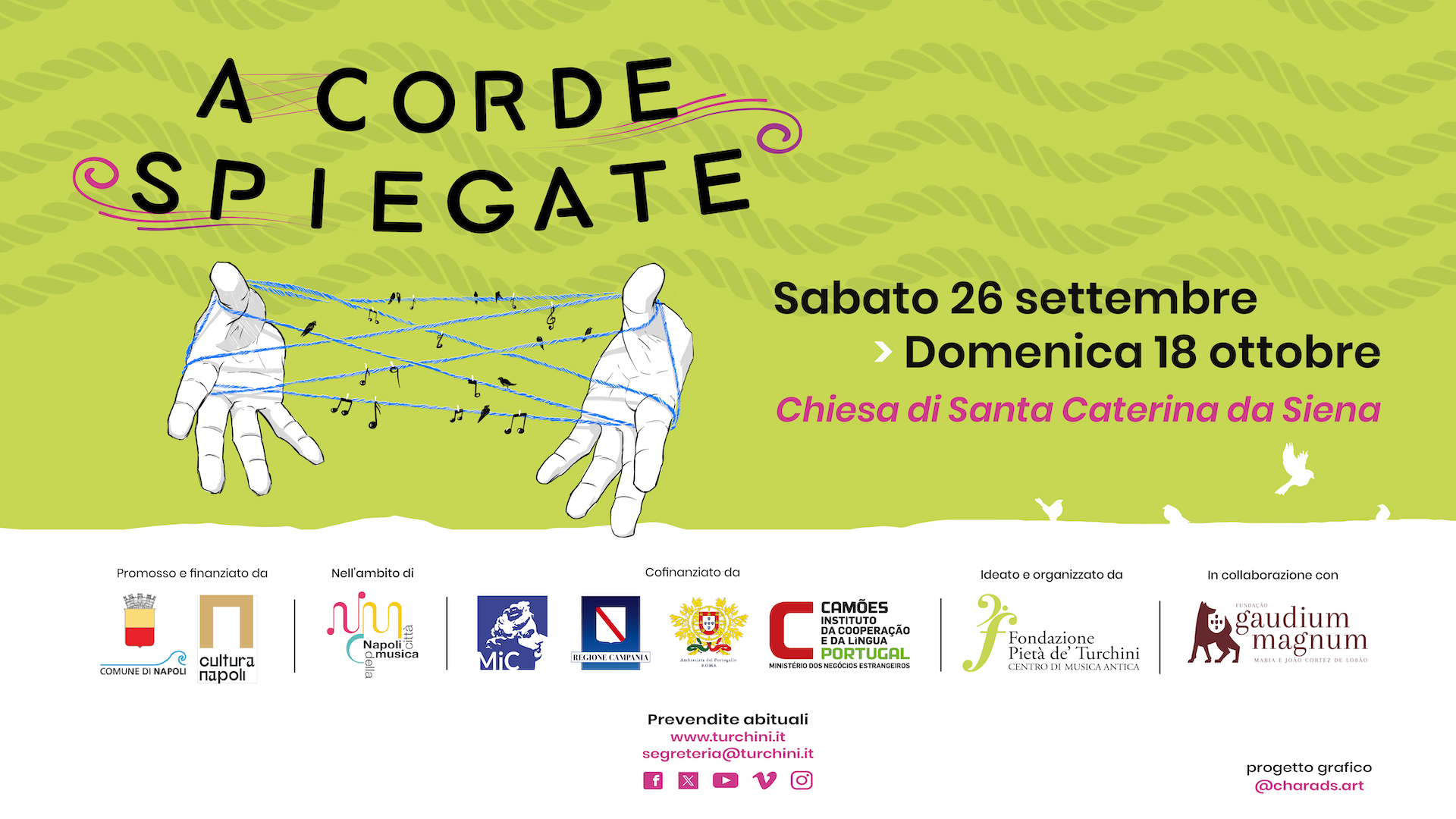
Festival "A Corde Spiegate"
- Ticket: € 5,00 €
for the series
A Corde Spiegate
Performers
Lorenzo Cavasanti, recorder
Yayoi Masuda, violin
Lorenzo Fantinuoli, cello
Laura La Vecchia, theorbo
Claudia Ferrero, harpsichord
The initiative is promoted and co-financed by the City of Naples as part of its 2026/2027 cultural programme.
TICKETS AVAILABLE ON SITE AND IN ADVANCE
Advance tickets can be purchased:
– online on the TicketOnLine – Azzurro Service website, no later than 12:00 noon on the day of the concert;
– at the designated Azzurro Service sales points;
– at the Concerteria sales point (via Michelangelo Schipa 15) or by phone at +39 0817611221.
RECOMMENDED PARKING
GARAGE GREEN PARKING NAPOLI
Via S. Carlo Alle Mortelle, 80132 – Naples
tel: 081 418515
directions
Further information
segreteria@turchini.it
Programme
G. Ph. Telemann (1681–1767)
Trio Sonata in F major, TWV 42:F8
Largo, Vivace, Affettuoso, Allegro
Sonata No. 2 in D major, TWV 41:D1
Allemande/Largo, Courante/Vivace, Sarabande, Gigue
G. F. Handel (1685–1759)
Trio Sonata in F major, Op. 2 No. 4, HWV 389
Larghetto, Allegro, Adagio
Recorder Sonata in C major, Op. 1 No. 7, HWV 365
Larghetto, Allegro, Larghetto, Gavotta, Allegro
G. Ph. Telemann
Trio Sonata in A minor, TWV 42:a4
Largo, Vivace, Affettuoso, Allegro
Splendori della triosonata
Programme notes
To make a name for themselves in the instrumental field, the young musicians of the Baroque period had to pass what was in effect almost an initiatory test: namely, managing to find a publisher willing to bring out a collection of trio sonatas — a genre that between the seventeenth century and the mid-eighteenth century enjoyed an extraordinary flourishing in every European country, from Spain to Saint Petersburg. The trio sonata made it possible to test the inspiration and technical mastery of aspiring composers, who had to prove themselves versed both in melodic writing and in virtuosity, brilliantly setting two solo instruments in dialogue — generally violins, recorders and transverse flutes, and oboes — with the accompaniment of the basso continuo. Once this hurdle had been cleared, promising career prospects almost always opened up for the young composer. From the first half of the seventeenth century onwards, the sonata — both solo and trio — branched into the chamber and church sub-genres: the former made up of a prelude followed by a series of dances, the latter of a sequence of movements of contrasting character. Later, the suite — which reached its greatest splendour in France — would derive from the former, while the Romantic sonata developed from the latter. Among the composers who made the most significant contribution to the trio sonata genre were Georg Friedrich Händel and Georg Philipp Telemann, two of the foremost figures of the German Baroque, who over the course of their very long friendship found time to converse not only about music but also about flowers (both were keen botany enthusiasts). This passion for vivid colours and intense fragrances finds full expression in these sonatas, written at different stages of their careers yet always steeped in a captivating melodiousness that continues to win over audiences even today.
Accademia del Ricercare is an association of musicians specialising in the performance of early music (11th–18th centuries), founded with the aim of recovering and disseminating its practice and culture.
In over twenty years of activity, the group — in its various formations — has given more than 1,000 concerts and has been invited to perform for major musical institutions and high-profile national and international festivals: (Bruges International Festival of Flanders, Festival de La Chaise-Dieu, Lens Festival Contrepoints, Bolzano Festival, University of León in Spain, I Concerti dell’Accademia in Ravenna, Early Music Festival in Graz, Festival de Música Española de Madrid, Festival de La Laguna in Tenerife, Festival Internacional de Música de Galicia, Festival Internacional de Música y Danza de Granada, Festival de Musique et Renaissance in Écouen near Paris, Antiqua BZ, Canto delle Pietre for the Lombardy and Piedmont Regions, San Simpliciano in Milan, Genoa, Florence, Campobasso, Viadana, Stresa, Noto, Brindisi, Pantelleria, Kiel, Hamburg, Barcelona, Albertville, Barcelonnette, Motril, etc.), meeting with excellent acclaim from audiences and critics wherever it has performed.
In 2009 it was commissioned by the Government of the Canary Islands and the Spanish Musicology Society to record the Villancicos of Diego Durón (Brihuega, 1653 – Las Palmas de Gran Canaria, 1731), a project that aroused great interest for its apt choice of instrumental forces as well as of period performance practice.
To date, Accademia del Ricercare has made 20 CD recordings (published and distributed on the international market by Brilliant, C.P.O., Elegia, Tactus, and Stradivarius), whose success is confirmed both by considerable sales figures and by the reviews published in the leading specialist magazines in Europe.